Hydrologic modeling is often seen as a manual, basin-by-basin effort. Historically, traditional model implementations at major utilities can take three or more years to fully deploy. This timeline is often inflated by extensive data auditing, IT integration, and the need for manual validation against decades of historical seasons. Because each basin is treated as its own modeling problem, the process is heavily dependent on local expertise and is notoriously difficult to scale. HydroForecast is shortening this timeline by leveraging a foundation model approach that gets to operational readiness within months.
A years-long timeline is increasingly at odds with the needs of today’s climate reality. As conditions become more variable and assumptions less consistent, the long timelines to build and maintain traditional models become harder to justify.
The traditional approach: building a model from scratch
In this conventional workflow, each basin is treated as its own modeling problem and the setup process can look something like this:
- Assemble and clean local data (precipitation, temperature, snowpack, streamflow)
- Delineate the basin and define sub-basins and routing
- Select a modeling framework
- Calibrate parameters to match observed flows
- Validate performance across time periods
- Deploy and maintain the system
This approach produces models that reflect local hydrology well. But it also means that setup can take years, be heavily dependent on local data and expertise, and hard to scale or keep up with increasingly volatile conditions.
HydroForecast flips this paradigm
Instead of building a new model for each basin, HydroForecast starts with a theory-guided hydrology foundation model trained across hundreds of diverse basins using global meteorological, satellite, geospatial, and in situ data.
Because our foundation model is pre-trained on global data, we bypass the years of manual data cleaning and validation that stall traditional projects. Rather than asking how to construct a model from scratch, the focus is on how to adapt an existing base model to represent local conditions and operations.
HydroForecast adapts to provide results sooner
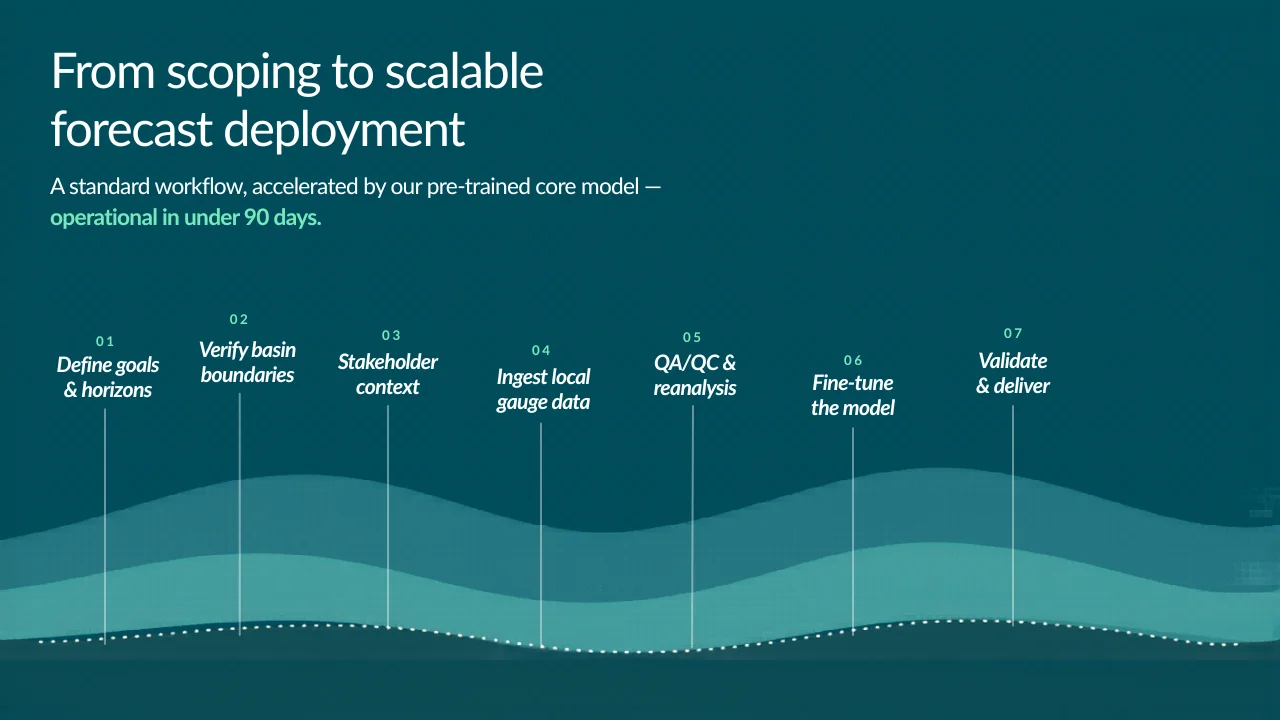
In practice, the workflow still involves many of the same ingredients — data, validation, and domain context — but applied with the latest modeling innovations to accelerate the path to a usable forecast:
- Define operational goals, assets, and forecast horizons
- Delineate and verify basin boundaries
- Incorporate local context from stakeholders
- Ingest local gauge data as available
- Perform QA/QC and reanalysis to look at past performance
- Fine-tune the model
- Validate results and deliver operational forecasts via the dashboard and API
Read the full guide to getting started with HydroForecast.
The key difference is that the core model is already in place, removing much of the upfront model development work. Our standard forecast offerings can be deployed in under 90 days.
Why deployment speed is a strategic advantage
Hydropower operators are often working across multiple basins, with different data availability and different operational constraints. The limiting factor isn’t just whether a model can be built — it’s whether forecasts can be deployed and maintained across systems without significant overhead.
-
Scalability: Because the core model is already trained, adding a new basin doesn't require starting over. Each additional site benefits from the same foundation, meaning organizations managing dozens of basins can deploy forecasts systematically. This is especially valuable when you need to prioritize high-impact sites quickly — ahead of an atmospheric river or the start of trading season.
-
Strength of the core model: Our industry-leading model architecture continues to learn and improve over time, delivering a smarter model that adapts with the climate.
-
Operational readiness: Quicker deployment means better decision-making sooner. Our timeline makes it possible for your model to go live before the season that matters most — before snowmelt, before hurricane season, or before a major storm moves through.
Don’t wait years for forecast data and better decisions. Talk to our team about getting HydroForecast live in your basin sooner.